
This is a current media and v minor celeb thing, marking the half-century since punk first made its spiky entrance: 1976, the year of the album Ramones, of first punk singles like ‘(I’m) Stranded’ by the Saints on Fatal Records in Australia and ‘New Rose’ by the Damned on Stiff Records in the UK, of the Anarchy tour by the Sex Pistols (my own university’s student’s union was one of the venues that banned their gig). Plus ofc much more.
There is celebration and commemoration, there are anniversary tie-ins, book publications, speaking tours, reissues of classics, and so on. Punk is in the air, and it’s generally presented as a good vibe achievement, all punkuddly and everything. Its survival shapes its history, partly via nostalgising reconstruction or distortion, and reshapes its past. Good old punk!
Hmm. Or praps FFS. But I just want to draw attention to a few of its, as the Pistols might have put it, ‘problems’, and its mythologisings. Lest we are carried away on the wave. Punk was a thing, a flawed thing. The flaws matter. Let’s be sharp-, not wide-eyed.
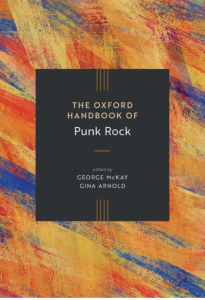
Drawing on just a small number of the 32 chapters in our 2025 book, co-edited with Gina Arnold, The Oxford Handbook of Punk Rock, here are a few punkorrectives.
Punk was a space of liberation. Kirsty Lohman: early punk ‘also replicated wider structural inequalities and oppressions. Early punk remained dominated by white, heterosexual, cisgender men, and those who deviated from this were at risk of abuse and assault inside and outside the scene. By the time punk had “gone underground” with anarcho- and hardcore punk in the 1980s, patriarchal norms, deep-rooted homophobia, and misogyny solidified in the many scenes…. Anti-sexist, anti-racist, and anti-homophobic discourses of “punk ideology” were not necessarily actualized in many punk scenes, but bigotry and abuse were experienced by many. Women and/or queer peoples’ broader subcultural participation and inclusion became more minimal and marginalized.’
Punk and violence against women. Helen Reddington: ‘The assertiveness and aggression shown by some women punks did not protect them from being attacked; equality with their male peers meant that they too got beaten up for looking and sounding extraordinary, and this threat was amplified if you were in a band…. [T}he more female members a band had, the more likely they were to be assaulted…. The problem of violence against women in punk music audiences was often just as bad as it was for the bands, even (or especially) when the bands playing were all-female…. Balancing the positive aspects of punk (such as empowerment and access to male space for women in the subculture) against the negative ones (such as sexual assault) is an understandable response to a female historian’s discourse… Even the mature performer Vi Subversa was continually troubled by the violent element of punk and the ways it made her feel, and was particularly affected by the aggression of the audiences in what became anarchopunk—ironically, with its strong emphasis on non-violence.’
Punk was DIY: rough and ready recordings. Samantha Bennett: Never Mind the Bollocks ‘was recorded at London’s Wessex Studios, an elite recording studio situated in a converted church in Highbury and synonymous with progressive rock recordings by the likes of Queen and King Crimson. At the time of the Sex Pistols’ recording, Wessex was equipped with world-leading recording technologies, to include two custom Cadac mixing consoles, including the 32-channel model used for the Sex Pistols; the UK’s first 3-M M79 24-track tape machine; and a range of cutting-edge processors, including the then-latest Neve, Urei, and DBX compressors and Eventide’s then-brand new digital processors, including the Harmonizer’.
Punk as anti-war. George McKay: ‘punk itself was part of Britain’s military culture and discourse…, punk culture is framed around war, violence, warfare, explosion, bomb. In punk and post-punk, what is to be expected when the scene produces or is produced by bands called names like (in Britain) the Clash, the Stranglers, or the Pistols, or—a swift A-Z—Anthrax, Blitz, Blitzkrieg, Blitzkrieg Bop, Conflict, Demob, GBH, Guns For Hire, Joy Division, London SS, Napalm Death (earlier name: Civil Defence), No Swastikas, the Partisans, Raped, Slaughter and the Dogs, the Spitfire Boys, UXB, Warsaw Pakt? For all its apparent anti-authoritarianism, punk was mired in militarism; for all its initial energy and driving shock, it seems it could only confirm an embedded social and cultural orthodoxy of violence.’
Punk (studies) as orthodox. George McKay and Gina Arnold: ‘punk and its studies have sometimes been surprisingly orthodox as a cultural and critical field. Above all else, we and our contributors have tried not to follow or uncritically repeat that orthodoxy…. [We] identify and explore core punk contradictions. These include, for example, its antiwar messages alongside not only its aggressive sounds but also its (often gendered) violence, its claimed antiracism alongside its dominant whiteness, its energy and attitudinality as a youth culture for an aging demographic, or its intermittent but persistent flirtations with populism and nationalism.’
References
Bennett, S. ‘Sound Recordists, Workplaces, Technologies, and the Aesthetics of Punk’. In G. McKay and G. Arnold, eds. 2025. The Oxford Handbook of Punk Rock. New York: Oxford University Press, 438-451.
Lohman, K. ‘Queer and Feminist Punk in the UK.’ In The Oxford Handbook of Punk Rock, 166-183.
McKay, G. ‘Rethinking the Cultural Politics of Punk: Antinuclear and Antiwar (Post-)Punk Popular Music in 1980s Britain.’ In The Oxford Handbook of Punk Rock, 481-501.
McKay, G. and G. Arnold. ‘Foreword.’ In The Oxford Handbook of Punk Rock, ix-xvi.
Reddington, H. ‘Danger, Anger, and Noise: The Women Punks of the Late 1970s and Their Music.’ In The Oxford Handbook of Punk Rock, 115-132.