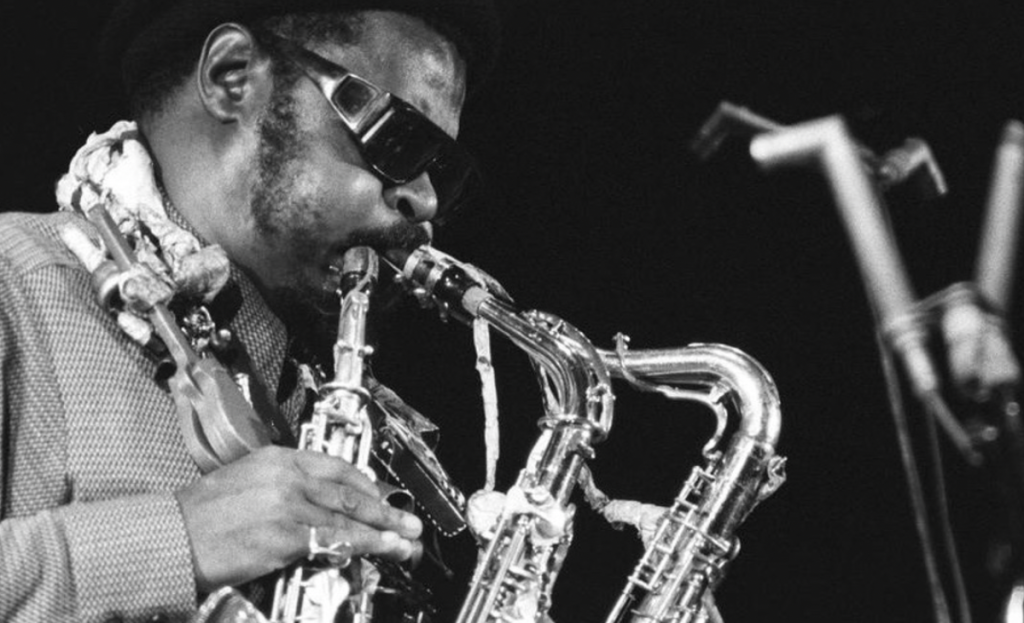
 Over the past year or two I’ve been researching the great African American saxophonist Rahsaan Roland Kirk (1935-1977), in the context of his disability. Or, rather, disabilities. Here’s a taster of the forthcoming work, to mark UK Disability History Month. It should be published in the leading scholarly journal Jazzforschung / Jazz Research, hopefully next year.
[This article] looks at the African American multi-instrumentalist, composer, bandleader and activist, Rahsaan Roland Kirk (1935-1977) as a compelling jazz figure in the context of disability. This starts most obviously with Kirk’s near-lifelong visual impairment, and then takes into account his stroke aged 40 and the impact of that on his subsequent period of live performances and recording.
Kirk was thus multiply-disabled, and looking carefully I hope at his life and music offers us understanding of what that means in jazz history and in disability theory, of course, but also in music, in life. As a remarkable wordsmith (we might say equally rapper or poet) Kirk had a word for this approach linking disability life and art: ‘audiobiography’.
The arguments are threefold. Firstly, I chart the limits of intersectionality in the context of the I think surprising lack of consideration given to him being disabled in extant scholarly work on Kirk. Compared with his colour, and black activism, there is rarely as much detail about his disability/ies, not even when, as I show, they are foregrounded in Kirk’s own work. Blacknuss!
Secondly, I examine in some detail the relationship between his visual impairment and his music, both in performance and composition. How did being disabled shape and inform his musical career? The Inflated Tear!
Thirdly, I look at the place of his exploratory and performative practice of adaptive and prosthetic instrumentalism, in particular post-stroke. Hey Babebips!
Overall, I want the detail of Kirk’s lived experience of multiple disabilities to stand in historical, theoretical and methodological dialogue. Rahsaan Roland Kirk was a creative crip, par excellence, twice over. This matters not only for any reappraisal of Kirk—to enrich our intersectional understanding, and place disability on an equal footing—, but also for jazz studies more broadly—because disability is an important feature of jazz—, and for disability studies—because creative responses to their disabilities by major artists seem often under-recognised or even unseen, and it is always time to uncover them.
For those interested, in terms of jazz and disability this research draws on recent and new work in the field, including:
- Fraser, Benjamin. 2023. Beyond Sketches of Spain: Tete Montoliu and the Construction of Iberian Jazz. Oxford: Oxford University Press.
- Heinze, Bill, and Atilla Hallsby. 2023. ‘What is the sound of one hand playing: aural body rhetoric in the music of Horace Parlan and Paul Wittgenstein.’ Rhetoric Society Quarterly 53(5): 733-747.
- Johnson, Russell L. 2011. ‘“Disease is unrhythmical”: jazz, health, and disability in 1920s America.’ Health and History
13(2): 13-42. - Lubet, Alex. 2011. Music, Disability, and Society. Philadelphia: Temple University Press.
- Lubet, Alex. 2013. ‘Oscar Peterson’s piano prostheses: strategies of performance and publicity in the post-stroke phase of his career.’ Jazz Research Journal 7(2): 151-182.
- McKay, George. 2019. ‘Jazz and disability.’ In Nicholas Gebhardt, Nicole Rustin-Paschal, and Tony Whyton, eds. The Routledge Companion to Jazz Studies. London: Routledge, 173-184.
- Rowden, Terry. 2009. The Songs of Black Folk: African American Musicians and the Cultures of Blindness. Ann Arbor: University of Michigan Press.
- Stras, Laurie. 2009. ‘Sing a song of difference: Connie Boswell and a discourse of disability in jazz.’ Popular Music 28(3): 297-322.
- Tonelli, Chris. 2016. ‘Ableism and the reception of improvised soundsinging.’ Music & Politics 10(2).