
Senseless Acts of Beauty: Cultures of Resistance since the Sixties (London: Verso, 1996) 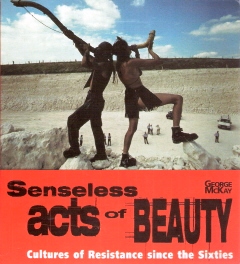
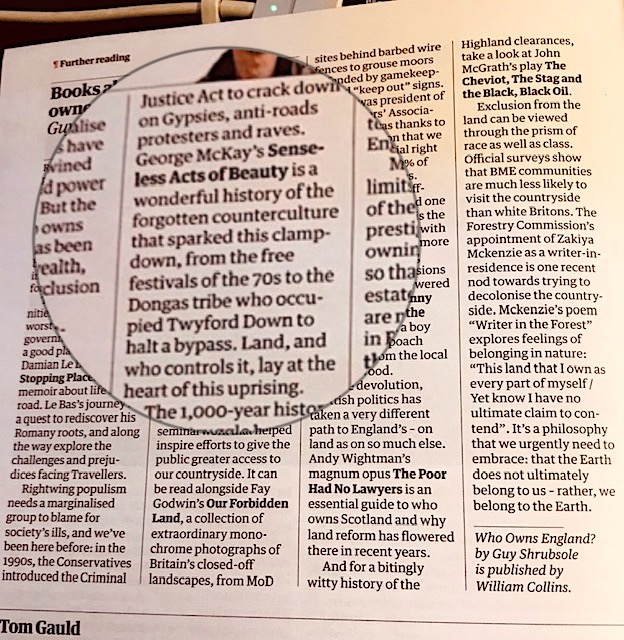
Activist performance can be understood within a wide range of different historical frameworks. [E]xamples [that] have been particularly influential [include] … George McKay, Senseless Acts of Beauty. Jenny Hughes and Simon Parry, Contemporary Theatre Review 25(3) (July 2015).
With a shock I realised this morning that next year will be the 18th anniversary of the publication of George McKay’s Senseless Acts of Beauty, an account of counter-cultural protest and DIY politics published by Verso. When I was a young rep in academic publishing, I loved this book. Along with Sarah Thornton’s Club Cultures from Polity Press (I still have the T-shirt – thank you, Polity), McKay’s work was one of the earliest serious books about the counter-cultural movements of the 1990s. I was working in Scandinavia in the run-up to publication, trundling around in the snow with a bag full of new book information for academics. To a certain amount of surprise, including my own, we found we had a hit on our hands. Senseless Acts of Beauty became adopted as a textbook in a number of universities and was much discussed in the press. The world of both McKay’s and Thornton’s books can be witnessed in the vibrant protest culture of my home city of Brighton – even our MP, Caroline Lucas, got detained by the police this week at the Balcombe anti-fracking demonstration. Since the mid-90s though, much activism has migrated online, so I wonder if it is still true that ‘ if there is resistance anywhere in Britain today, then it is here, in the beat-up buses, beleaguered squats and tree-top barricades’. Maybe I am too long in the tooth now to be able to comment on whether Thornton’s analysis of the ‘hierarchies of hipness’ is still valid – but it does seem that people continue to get up and do something to show they care, and dance while they do it, as in the One Billion Rising demonstrations. I wonder what McKay would have to say about the flash mob? EJ Drew, The Old Reading Room (20 August 2013).
George McKay made a significant contribution to the ‘consciousness’ of the protest movement with his seminal study of the radical protest since the 60s, Senseless Acts of Beauty. Jeremy Gilbert, ‘Reflections on Britain’s student movement’ (2 March 2012).
As obnoxious and anti-social, Crass came to be considered an icon radical-chic, launched a style, a patented design with great success, taken from hundreds of bands (and not only). They fielded amazing ideas as their "expiration date" when they formed they decided that they would split up in 1984. And so they did. Musically, alternated marches a little punk 'wrecked in moments of brilliant experiments apocalyptic. They were, in addition to Discharge, the theoretical maximum of punk-rock paranoid. They moved in different artistic fields and communicative, with unity of purpose, originality and autonomy. They were one of the few groups to truly embody the meaning of DIY and self-management of the music.
Finally, we have represented a valuable source of inspiration, on all fronts. The reason is clear from the text downloadable below: This is the chapter that George McKay dedicated to the English group in the essay "senseless acts of beauty" (1996, Italian edition: Shake 2000); still one of the best things written about [the band], a summary of reasoned thought about Crass.
Review of Crass chapter from Atti Insensati di Bellezza. Pseee Pseee blog (4 May 2011).
In my constant search for the hidden histories of the UK, I have come across all kinds of books, websites, records, places and people that fall outside of mainstream discourse; they make up a fascinating counter narrative that I’m having to piece together bit by bit. What I learnt at school didn’t help that much, and neither does the mainstream press.
I came across George McKay’s excellent book Senseless Acts of Beauty in a rather round-about way; reading the liner notes ‘May Inspire Revolutionary Acts’ by The Mob (excellent eighties anarcho/traveller band, who were part of the squatted community in Brougham Road, Hackney) it mentioned the book in positive terms…. Dutifully/ obsessively I tracked the book down (finding out it was published by the ever excellent Verso Books) and was mightily impressed and enlightened.
The book finishes with the passing of the Criminal Justice Act and the ramifications that had; the book was written in 1996 and obviously a lot has happened in the years between then and now, but this is an essential read for anyone interested in the history of the counter-culture in Britain, and an inspiration to anyone involved with the current protest movement—you realise you’re not alone, and never were, rather you’re part of a grand tradition that needs to be remembered and discussed. Gary Budden, New Lexicons (April 1 2011).
Books on the modern era: our guide to what you should read if you only have a lifetime…. George McKay Senseless Acts of Beauty: Reveals the direct link between the different eras of hippies, punks and ravers in the UK, between the 1970s, the 1980s and the 1990s. Modern Music Review (2009)
By establishing connections to anti-colonial or civil rights struggles of the 1950s, it is possible to grasp exactly what is changing and when it changed. Exemplary here is George McKay’s study of British resistance and protest since the 1960s. His work makes particularly clear the importance of post-1960s festivals to ongoing radical protest. Apart from McKay there seems to be no single author or tradition that is dominant, simply an ongoing accumulation of studies. Tim Jordan and Adam Lent (eds.) ‘Introduction’, Storming the Millennium: The New Politics of Change (London: Lawrence and Wishart, 1998, 8).
I did a couple of papers a few years ago on the connections between the different post-60s movements, and couldn’t at the time find any recent academic work which wasn’t keen to fragment things and isolate specific events, movements, subcultures etc. for analysis. A lot of German and American work did take it for granted that there were such connections, and to be fair some German researchers have looked at movement cultures *as cultures*, as has Melucci to some extent. But it’s precious little. There are a couple of books from the 60s and 70s which make the substantive point but in such a way that they’re unlikely to convince many people in the 90s…. So McKay’s book was wonderful, because here was someone finally talking about the same things I was researching, but from the opposite angle, of tracing the specific connections between movements and cultures in one time and place, rather than trying to theorise (as I am) an experience of running into related mental and social worlds in a whole range of countries and trying to come at that from a bottom-up ethnography on the one hand and a top-down theory on the other and hoping they met in the middle. Lawrence Cox, discussion board (30 June 1998).
[T]he first thing to be said about George McKay’s book is that it is a good read…. [O]ne can’t wait to turn the page to see how the narrative unfolds, how the spirit of change manifests itself and how the protagonists respond. Like any telling of a historical tale, when it is done well one is encouraged to suspend what one already knows and imagine what might have happened. At the end of Senseless Acts of Beauty (a problem in itself as McKay confesses that there is no conclusion), it can be said that, irrespective of how such effective one thinks the action to be, there is at least the feeling that some political action is happening, that motivation for radical change is still in evidence…. This is not a theoretical book, in fact it refuses to privilege theoretical discourse, preferring instead to remain faithful to one of its key themes: accessibility…. [T]hs aside, the book is compelling, inspiration and timely. It should be read by as many people as possible, many of whom will ask themselves one question: what have I been doing all this time? Neal Curtis (1997), Body and Society, 3:3, 113-116.
[McKay] wants to have his gateau, and eat it too. He likes to confess his own participant-enthusiast point of view, but then pull back into analytical, anthropologist mode. He excels at both.… He demonstrates convincingly that the ‘60s were not some fluke and that countercultural practices popularized then have fed pockets of resistance ever since. Brad Wieners, Wired (US edition, September 1996, p. 181)
… this rich archive collection. Sabine Janski, in German newspaper Die Tageszeitung (15 July 1996)
A history of an unwritten tradition … one of the most enjoyable books to be published this year … an account of very moral people consciously trying to create a new politics. Alison Page, books of the year in Red Pepper (December 1996, p. 36)
Absorbing history … succeeds in unravelling various tangled threads from two decades of countercultural history. Dave Rimmer, Mojo (1996, p. 123)
The secret history of the last two decades. Jon Savage, author of England’s Dreaming: Sex Pistols and Punk Rock
This is a book that has already been dismissed with contempt by many people we know within the movement(s) it describes. Various types of criticisms have been expressed, but what they share overall is a dislike of McKay’s ‘approach’ to his subject matter. In our language, this approach is one of recuperation – it is an attempt (not necessarily deliberate) to appropriate antagonistic expressions and render them harmless through transformation and integration into some form of commodity (in this case, academia and the world of coffee-table publishing)…. The sections on the free festivals and fairs of the 1970s are written by McKay in his role as someone who took part. For those of us who don’t know much about these scenes, McKay’s account presents itself as a detailed and useful history, indicating some of the conflicts among those involved as well as their run-ins with the cops etc. Review in Aufheben, no. 5 (Autumn 1996)
Excellent.… Using interviews, flyers, DIY newsletters and magazines McKay has drawn together an important record of the endlessly rebellious vein in British society which has managed to circumvent every attempt to smother it. The Big Issue (May 1996, 36)
… an immensely useful history of the past 30 years of British resistance culture.… McKay’s worries about whether the new tribes can crystallise into a counter-systemic force… are well expressed. Pat Kane, New Statesman & Society (10 May 1996, 38-39)
An almost complete study of UK counter culture,1974-95: Windsor, free festivals, tipi people, Albion Fairs, Crass punks, the Convoy, Rainbow Village, Greenlands farm, the Glastonbury New Age party, Castlemorton, Madchester squat-raves, Claremont Rd, Twyford dongas, anti-CJA-ers, Justice?, United Systems… Superb quotes, long words, footnotes and pics. I’m glad he wrote it ‘cos now I don’t have to (and I don’t remember so much… page 23 reminds me of wild dancing at Stonehenge). Dice George, Stonehenge Campaign newsletter (Summer Solstice 1996)
George McKay’s exuberant new book is in part a celebration of the do-it-yourself politics favoured by modern protest movements and alternative cultures. Yet it is also a lament against the erosion of traditional liberties by a government that claims to make the sovereignty of the individual the heart of its political and economic credo. McKay rightly identifies a surviving strand of libertarian resistance to the acquisitive, low-level authoritarian mainstream of British society. Aidan Rankin, The Tablet (11 January 1997, 45)
A strength of the book is the way in which the history of events and developments is pieced together, and links are made between them, showing an evolution and exchange between them. For example, McKay shows some of the exchanges and meetings between travellers and peace campers throughout the 1980s. Karen Goaman, Anarchist Studies (77-82)
At the recent Earth First! gathering in North Wales, an activist quipped that this book should be boycotted because of all the inaccuracies it is supposed to contain regarding recent road protests. This, I feel, had more to do with over-sensitivity on the part of those who have lived and breathed the events described, rather than excessive sloppiness on the part of the author. Everyone has a different slant on any given situation. McKay’s task has been to steer as truthful a course as possible through the choppy waters of contradiction, exaggeration and ego, to link up three decades of underground culture. Drawing on fanzines, free papers, lyrics, interviews and diaries, Senseless Acts journeys from the free festival scene in the mid-seventies to Castlemorton’s rave explosion in the early nineties. With punks, travellers, Molesworth, Teepee Valley, Twyford Down and the Criminal Justice Act providing the landmarks, this as a must buy/blag for anyone who’s ever wafted the joss-stick of defiance under the nose of repression. The counter-culture is building its own library. Neil Goodwin, Peace News no. 2405
The title is offensive. I thought of all the people present at the Battle of the Beanfield, the Molesworth eviction, Yellow Wednesday, the 1990 poll tax demo in Trafalgar Square, the Newbury evictions and the countless other landmarks of our “cultures of resistance”. Most of these events were not inspired by “senseless” people. Some were far from beautiful…. Ultimately, I am glad that someone has tried to write a book bringing together different strands of protesting and partying. We have only ourselves to blame if this is the only written history we ever get. The incentive now should be to impart our beliefs and history in our words and not just to ourselves, but to the mainstream, who live, largely, ignorant of the strength of our existence. If Senseless Acts of Beauty inspires one 16 year old to go out and lock on, set up a sound system or live in a bus, then it has done a good job. It is just a shame that it has been done by an academic, in a verbose, uncreative style and not by ourselves. Earth First! Do or Die, no. 6
George McKay offers a vision of an alternative cultural order … he surveys the history of free festivals and radical social movements in Britain. He sees them as part of a culture of resistance, through which music and other forms of cultural expression play a decisive part, and he makes an explicit connection between cultural form and cultural organization.… For McKay, therefore, cultural battles are also political ones. But for him, culture is not just about artefacts; it is about the way they are produced. McKay believes that to produce cultures of resistance you need alternative forms of life and cultural production.… [Greil] Marcus and McKay raise a question about both the type of organization and about how the art acquires political significance. They appeal to different notions of popular culture and democracy. John Street, Politics and Popular Culture (Polity, 1997, 195-196)
One reply on “Senseless Acts of Beauty”
[…] http://georgemckay.org/reviews/senseless-acts-of-beauty/ […]