
 As in playing music, and writing it, not writing about it. I’m a semi-pro double bassist, playing mostly jazz and improvised music, writing a bit, playing locally for my own pleasure. On these pages you can find out about my musical history—bands and projects I’ve been involved with in the past, over getting on for 40 years—as well as my current music. Book one of the bands! We all know life without music is empty and meaningless. Gigs are listed here. Scroll down or look at the drop-down menu and you’ll find information about my playing in the following places and times:
- Norwich 2016-
- Lancaster 2010-2015, with my new bass
- Lancaster and the north-west, 1990s-early 2000s
- Glasgow, late 1980s-early 1990s
- Norwich 1980s.
Also on these pages are some images of bands I have been in—and occasionally out of—over the decades. There are probably a few more to be added… (Recordings! I need to put some of the older music up too.) Recognise yourself? Do get in touch. I can safely say that almost all the musicians I’ve ever been lucky enough to play with I’d be pleased to hear from, really. And only one ever was a prize asshole, that I can remember.
I moved from playing acoustic guitar when I was 13-14 to bass guitar aged 15-16 in the mid-1970s to double bass at the age of 23, and have stuck with double bass ever since (and indeed the same instrument for over a quarter-of-a-century until 2010. Then I bought myself a 19th c. German bass, which generously improved my sound. I had significant work done on this bass in 2010 and 2020).
To a large extent I am what is called ‘self-taught’, except for my formal weekly training when I worked with Community Music East in Norwich in the mid-1980s, and a regular arco lesson with terrific cellist Maja Bugge in Lancaster for a year or so around 2013. Obviously I have also learned from practically everyone I’ve ever played with. (I would really like to spend a year or two with a double bass tutor working on arco technique, reading and extending my jazz theory, if I could find a really good player and teacher now in the Norwich area, please.)
Here is a recording and video from 2020, made with Chris Dowding (cornet, fx) and Paul Thompson (film) during the pandemic. It’s a version of a well-known 19th c. Sacred Harp shape-note piece, ‘Idumea’. (See here for sheet music.)
And here’s a snippet of some other footage I like, from when hymn played in Norwich a couple of years go. The band following us, a blues duo of guitar and voice, asked us after our set if we’d join them for their first number, ‘a swampy slow bluesy vamp, Dm to F and G, then round and round’, the guitarist whispered. The piece ended up being about 10 minutes long, and this is one of them.
Norwich 2016-
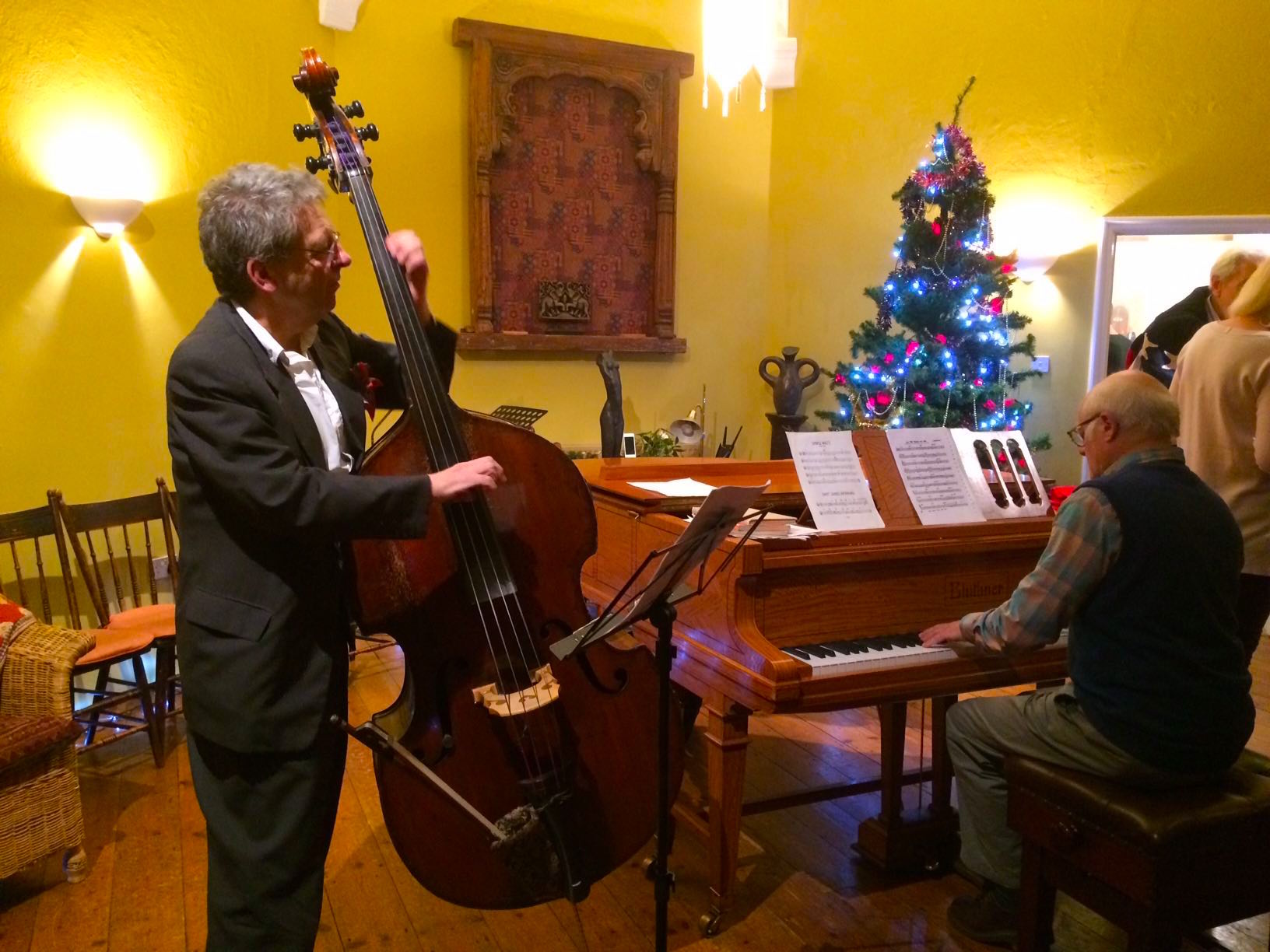
Having moved (back) to Norwich in late 2015, I began looking for some interesting music and musicians to play with, a band or two to join or form. I found a local luthier who rehaired my bow (it was practically bald), and I put some brand new strings on the bass in preparation. Was itching to play some gigs! I managed to get involved in making a variety of sounds, from English folk to Jewish cabaret, electronica to improv, modern jazz standards to original compositions. Most of the bands below are available for booking, folks (support live music, especially after the pandemic), you just got to get in touch.
You can find out a little more about each active Norwich band below via the drop-down menu.
Joey Herzfeld Trio
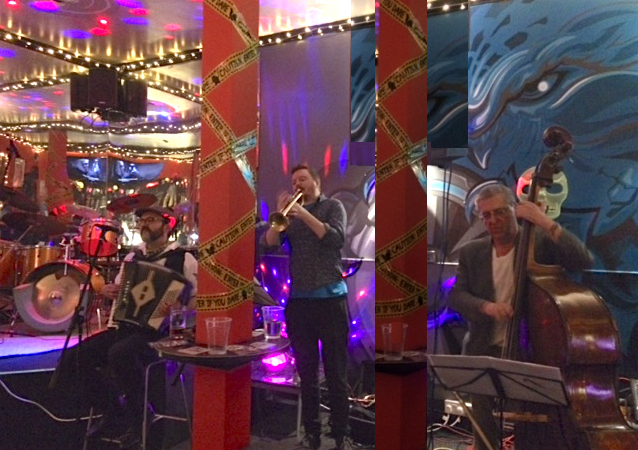
feat. Joey on accordions, piano, voice, Chris on trumpet, me bass, playing Joey’s songs, which I describe as sort of English/Jewish folk, with improvisations. He calls his music ‘horror folk’. I’d say with added semi-tones and chord changes, and a bit of cabaret. Below, a video of us doing Joey’s ‘Play with fire’, early 2017. OK, gone a bit quiet this band recently, tbh, though I do play bass occasionally on a recording of one of Joey’s quirky songs. He sends me a lead chart and the recording to a click and I work a bass part out, record it, send it back. (See ‘Strange dreams’ below, from 2024.) Think the band’s finished now. People liked that trio; when it cooked it really cooked, plus Joey is a bit spiky as a frontman.
One reply on “Music”
Interesting.Some music would be good. Anything from your long and active past in music?